Enter the Cave. Confront the Shadow. Return in Right Order.

The Powers
INNER BATTLEFIELD
3/2/2026
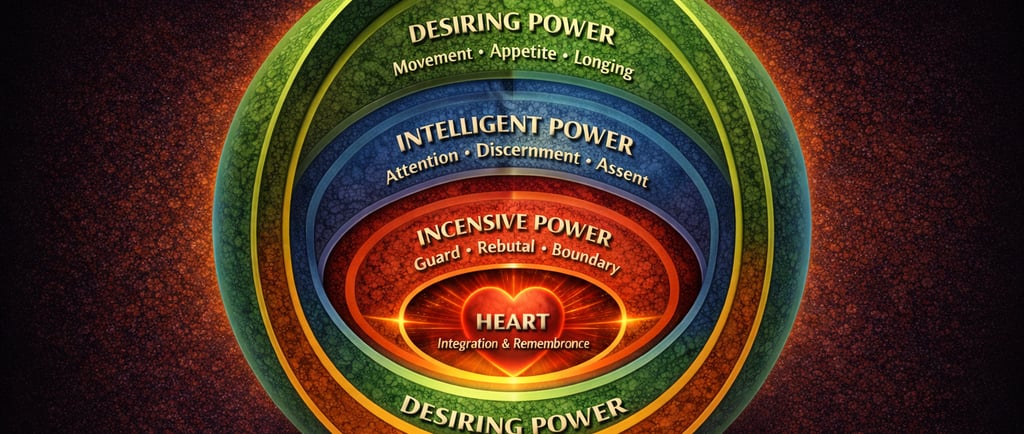
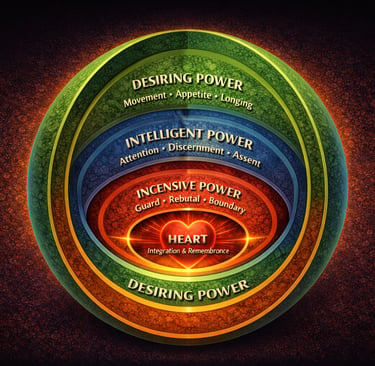
This article explains a visual model that depicts the human interior as a cross-section sphere with layered powers surrounding a central heart. The purpose is practical. The model is intended to support observation, objective determination, and correction in real time.
Across multiple traditions, different vocabularies describe similar mechanics. Impressions arise, inner faculties respond, and the person either returns to a stable center or moves into a predictable sequence of capture.
The Diagram Structure
Layers from outer to inner
From the outside moving inward:
Desiring Power (outer sphere): movement, appetite, longing
Intelligent Power (next sphere): attention, discernment, assent
Incensive Power (next sphere): guard, rebuttal, boundary
Heart (center sphere): integration and remembrance
The ordering represents exposure and governance.
Desiring power is placed outermost because it naturally moves toward objects and experiences and is easily recruited by impressions. Intelligent power is positioned inward because it interprets what arises and determines whether assent is granted. Incensive power is positioned closer to the center because it supplies protective opposition after discernment. The heart is central because it functions as the integrative locus that stabilizes the person and supports return.
Heart
Integration and remembrance
In this model, “heart” does not refer primarily to emotion. It refers to an integrative center where attention can become unified and where the person can return when fragmented.
A stable center tends to reduce compulsive substitution, reduce reactive hostility, and reduce narrative-driven justification. Practices such as prayer, dhikr, self-remembering, and mindfulness-return can be understood as methods of returning attention to this center.
Intelligent Power
Attention, discernment, assent control
Intelligent power is treated as the aiming faculty. It supports:
noticing what is present
naming the movement
testing the impression
granting or refusing assent
directing the other powers
Assent is a critical hinge. Many disturbances become binding because assent is granted automatically. When intelligent power is trained and active, disturbances are often detected earlier and addressed with less collateral reaction. When it is inactive, the other powers tend to operate mechanically.
Incensive Power
Guard, rebuttal, boundary
Incensive power is treated as a protective force. It supplies refusal, boundary energy, and rebuttal against intrusive movements and against what is perceived as unjust or corrupting.
In a regulated state, this power supports firm boundary without hatred. In a dysregulated state, it may be diverted into rancor, contempt, and cruelty. When that diversion occurs, intelligent power often shifts from discernment toward justification, which further stabilizes the distorted state.
Desiring Power
Movement, appetite, longing
Desiring power is the movement-toward faculty. It includes appetite, attraction, pursuit, longing, and persistence.
In a regulated state, desiring power supports steady aspiration toward what is valued, including truth, devotion, restraint, and sustained practice. In a dysregulated state, it tends to manifest as craving and attachment, and it often produces substitution. Substitution refers to an attempt to use an object, experience, status, or stimulation to supply stability and wholeness that the center is meant to provide.
Desiring power is depicted as the outer sphere because it is most exposed to incoming impressions and promises of pleasure, relief, and identity.
The Outside Field
Impressions and provocations
Outside the spheres is the field of impressions and provocations. This includes thoughts, images, memories, bodily sensations, cravings, social triggers, and ambient suggestion.
The model assumes that impressions cannot be fully prevented. The key variable is what occurs after an impression arises. In practical terms, the transition from mere appearance to capture depends on coupling, assent, repetition, and habit formation.
The Capture Chain
How an impression becomes captivity
The rim of the diagram presents an operational sequence:
Provocation → Coupling → Wrestling → Passion → Assent → Actualization → Captivity
Each stage has a recognizable function.
Provocation
A thought, image, or trigger arises. Appearance alone is not treated as ownership.
Coupling
Attention sticks to the provocation and begins elaborating it. This is commonly expressed as replay, fantasy-building, or narrative extension.
Wrestling
A decision point occurs. Refusal and return remain possible, and feeding the movement remains possible.
Passion
A stable affective state forms and tends to recur. Imagination and emotion reinforce each other.
Assent
Consent is granted internally. The impression is treated as legitimate, true, necessary, or justified.
Actualization
Speech and behavior enact the assent.
Captivity
Habit forms. Triggers produce predictable outcomes. The person reports being carried by impulse or compulsion.
The model implies that earlier intervention is typically more effective than later intervention.
Fail Modes
Two common collapse vectors
The diagram includes two common distortions.
Desire hijack
Craving → Attachment → Substitution
Desire becomes urgent, then binding, then oriented toward a substitute source of stability.
Incensive hijack
Hatred → Rancor → Contempt
Protective force becomes person-directed hostility. Contempt often marks a stabilization of this distortion.
Recovery Line
Return of attention to the heart
The recovery arrow is framed as a single motion: attention returns to the heart through prayer, dhikr, self-remembering, or mindfulness-return.
Functionally, this return tends to restore discernment as the aiming faculty and tends to re-aim desire and force under the governance of the center.
Practical Application
A three-question field test
The diagram can be used as a diagnostic in moments of disturbance:
Which power is being recruited: desire, force, or intelligence
Where the process is on the chain: provocation, coupling, wrestling, or later stages
What small action breaks coupling and supports return: refusal of assent, short return phrase, posture shift, breath reset, attention re-anchoring
Conclusion
The model frames inner work as governance and purification rather than suppression. The heart functions as an integrative center. Intelligent power governs assent. Incensive power protects through boundary and rebuttal. Desiring power supplies movement and longing.
Capture is described as a staged process that begins with provocation and often becomes captivity through coupling, assent, and habit. Recovery is framed as return of attention to the center through established practices of remembrance.content
Awareness
Presence
© 2026, All rights reserved upon all original content presented by From Shadows. Re-use of content within context and link to website is noted within, re-use is hereby granted.
From Shadows provides educational and spiritual content for personal development. We do not provide medical advice, diagnose conditions, prescribe treatment, offer psychotherapy, or provide legal or financial advice. Participation is voluntary. You are responsible for your choices.